

Debt-to-Income Ratios Explained Like a Volleyball Playbook
Why Most Borrowers Get Bench-Warmed by Lenders in 2026
Imagine stepping onto the court for the championship game. The crowd is roaring, the stakes are high, and you are ready for the perfect set. In the world of Austin real estate, that championship game is buying your dream home. But before you can spike the ball and close the deal, you need to master the fundamentals. In the mortgage playbook, the most critical fundamental is your Debt-to-Income ratio, commonly known as DTI.
As we navigate the shifting market of 2026, many eager homebuyers find themselves benched by lenders. Why? Because they do not understand the hidden rules of DTI. Just like a volleyball coach evaluates a player’s vertical jump and reaction time, lenders evaluate your financial agility. At Nest Mortgaging, Erica Billé and her team believe that one size does not fit all. We are here to act as your financial coaches, ensuring you stay on the court and out of the penalty box.
- The Setter: Your gross monthly income.
- The Spiker: Your recurring monthly debts.
- The Net: The lender’s strict DTI thresholds.
Let us dive into the playbook and reveal the hidden thresholds that even seasoned real estate agents often miss.
The Front Row: Breaking Down Your DTI Thresholds
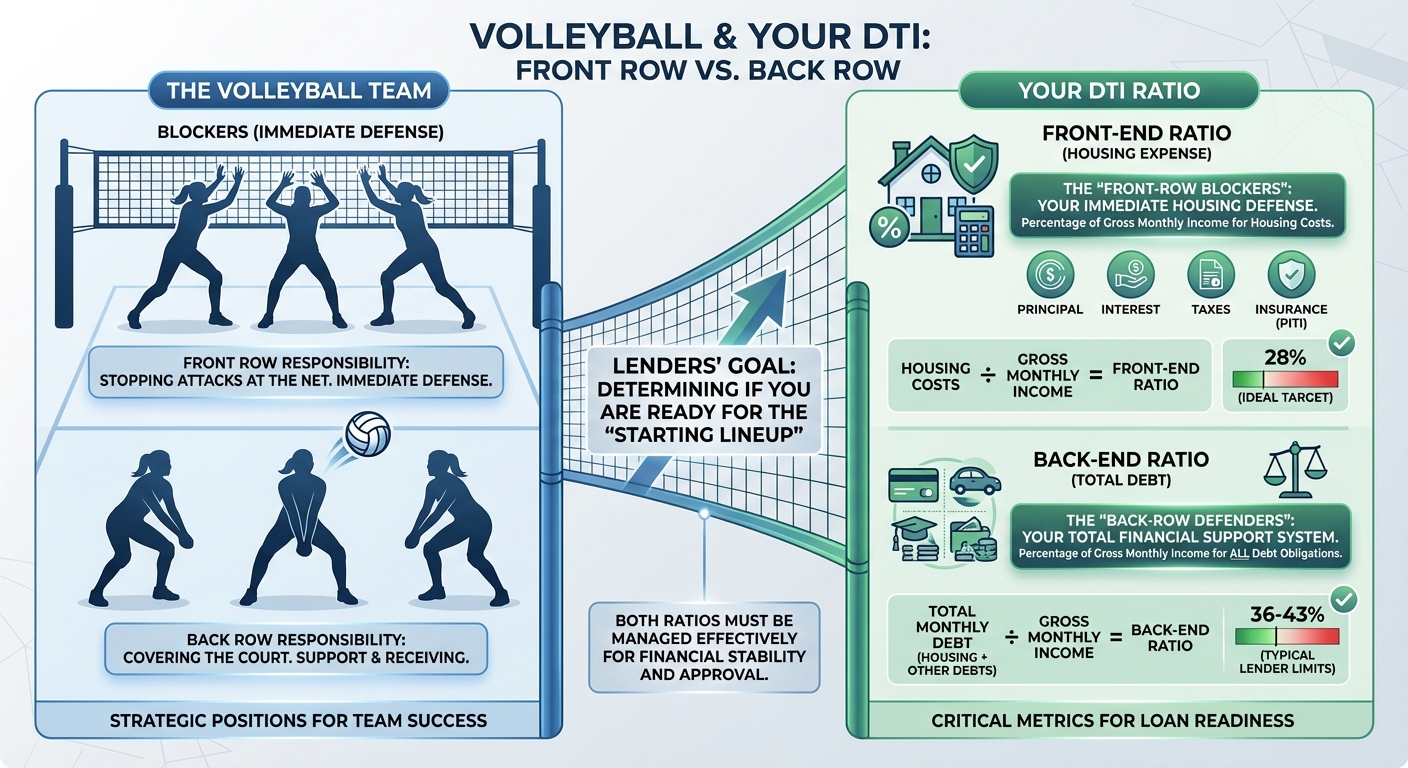
In volleyball, you have the front row and the back row, each with distinct responsibilities. Your DTI works exactly the same way. Lenders look at two specific numbers to determine if you are ready for the starting lineup.
Front-End Ratio: This is your housing expense ratio. It represents the percentage of your gross monthly income that goes toward housing costs, including principal, interest, taxes, and insurance. Think of this as your front-row blockers, acting as the immediate defense against housing costs.
Back-End Ratio: This includes your housing costs plus all other recurring monthly debts like student loans, car payments, and minimum credit card payments. This is your back-row defense, the libero of your financial profile, ensuring no hidden debts hit the floor.
In the evolving 2026 Austin market, lenders are adjusting their playbooks. While the traditional rule of thumb was a 43 percent back-end limit, modern loan programs have different flexibilities. Working with a dedicated mortgage broker like Erica Billé gives you access to over 60 lenders, meaning we can find a playbook that fits your specific stats.
| Loan Program | Typical Front-End DTI Limit | Typical Back-End DTI Limit | 2026 Market Notes |
|---|---|---|---|
| Conventional | 28% | 36% to 45% | Highly dependent on credit score and down payment. |
| FHA | 31% | 43% to 50% | More flexible for first-time buyers in Austin. |
| VA | No strict limit | 41% | Relies heavily on residual income calculations. |
| USDA | 29% | 41% | Strict limits but offers 100% financing options. |
Calling a Time-Out: How to Improve Your Stats
Your Pre-Game Warm-Up Plan
If your stats are looking a little sluggish, it is time to call a time-out. You do not have to stay on the bench forever. With the right coaching and strategy, you can improve your DTI and get back in the game.
- Pay Down Strategic Debts: Not all debts are created equal. Focus on eliminating high-payment, low-balance accounts first to free up monthly cash flow.
- Increase Your Income: Whether it is taking on a side hustle or negotiating a raise, boosting your gross monthly income directly dilutes your DTI percentage.
- Consolidate Debts: Rolling multiple high-interest payments into one lower monthly payment can significantly improve your back-end ratio.
At Nest Mortgaging, we prioritize real human connection. We do not just run your numbers and reject your application. We sit down with you, review your financial playbook, and create a custom strategy. If you have questions about your specific situation, you can always reach out to Erica at erica@nestmortgaging.com or call 12108798579. Let us make your next steps easier and secure your spot in the Austin housing market.
Q1: What is a good debt-to-income ratio for buying a house in Austin?
Generally, lenders prefer a back-end DTI of 36% or lower. However, depending on the loan type and your credit score, many borrowers in Austin get approved with a DTI up to 43%, and sometimes even 50%.
Q2: How do lenders calculate my back-end DTI?
Lenders calculate your back-end DTI by dividing your total recurring monthly debt payments (including your future mortgage payment) by your gross monthly income, then multiplying by 100 to get a percentage.
Q3: Can I get a mortgage with a DTI over 43 percent?
Yes, it is possible. Certain programs like FHA loans or specialized conventional loans allow for a DTI up to 50% if you have compensating factors like a high credit score or substantial cash reserves.
Q4: Does my credit score affect my DTI limits?
Absolutely. A higher credit score acts like a star player on your team, giving lenders the confidence to allow a higher DTI ratio because you have a proven history of managing debt responsibly.
Q5: Why should I choose a mortgage broker like Nest Mortgaging over a direct lender?
A direct lender only offers their own loan products, meaning if you do not fit their specific playbook, you get benched. As a mortgage broker, Nest Mortgaging has access to over 60 lenders, allowing us to shop around and find the perfect loan solution for your unique financial stats.


